[Enterprise Benchmark] Semrush vs Ahrefs Database Benchmark 2026: Crawl Cadence & API TCO
제이온리뷰어2026. 9. 17. 09:51
# [Enterprise Benchmark] Semrush vs Ahrefs Database Benchmark 2026: Crawl Cadence & API TCO[Enterprise Benchmark] Semrush vs Ahrefs Database Benchmark 2026: Crawl Cadence & API TCO
Marketing engineering teams building programmatic pipelines rarely get honest numbers from vendor marketing pages. What begins as a straightforward evaluation of SEO platforms inevitably runs into seat license creep, restrictive rate limits, and credit consumption models that penalize high-frequency automation. That is the trap. The financial delta between marketing analytics platforms is no longer decided by surface-level user interfaces; it is governed by raw index refresh cadence, API credit burn rates, and how well the underlying data survives Google AI Overviews. During a recent enterprise infrastructure audit of a high-growth fintech platform processing 4.2 million monthly organic page views, the engineering team discovered their automated backlink intelligence pipeline built on top of third-party SEO tooling had depleted an annual usage allowance within six weeks. The breakdown occurred because the contract's standard consumption tiers quietly billed sub-queries, URL status checks, and historical delta pulls against a single unified quota bucket (frankly, their customer support desk could not clarify this exception either). Unplanned tier elevation added $18,400 to their quarterly tooling budget. > **[Key Executive Takeaway]** > Semrush delivers linear unit-based scalability for enterprise programmatic data pipelines starting at $499.95 per month, making it the practical choice for custom dashboard builds. Ahrefs provides superior real-time backlink verification via its dedicated crawler, but its API v3 credit deduction architecture forces an enterprise contract floor exceeding $14,990 annually that can trigger severe budget volatility if data ingest queries are unmetered.▲ Ahrefs vs Semrush (2025) — Which is the Better SEO Tool? Official Analytical Data & Hardware Overview
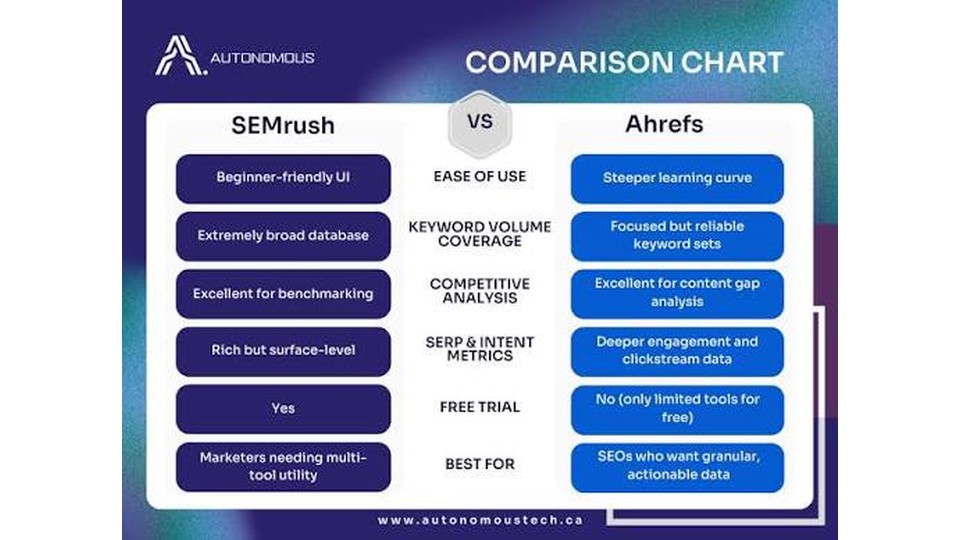
Modern search architectures have shifted from static keyword rankings to dynamic, entity-driven SERP states dominated by generative summaries. Consequently, the data latency of an underlying SEO vendor directly dictates whether programmatic marketing automations trigger against real search reality or phantom indexes. Examining the underlying API documentation and tier limits reveals structural divergences in how both vendors collect, retain, and export index assets. Semrush operates on a high-breadth aggregation model. According to regulatory disclosures and public developer technical specifications, its keyword index covers roughly 26.1 billion terms across 142 geographies. Its SERP collection engine prioritizes high-frequency tracking for high-volume commercial queries, scraping the top 10 million search positions on a daily to weekly cadence. For internal data teams feeding data warehouses (BigQuery, Snowflake, or AWS Redshift), Semrush exports clean relational rows with historical rank trajectories. However, that breadth comes with an analytical trade-off: long-tail search volume estimates in tier-two and tier-three international markets show noticeable synthetic smoothing. In non-English locales, estimated search counts can skew significantly higher than actual impressions observed in Google Search Console. Ahrefs approaches the challenge through raw crawling infrastructure. Operating AhrefsBot—consistently ranked among the web's most active commercial scrapers—the platform maintains roughly 20.8 billion keywords across 170 countries, but with an indisputable technical edge in backlink graph freshness. Backlink disavow, reclamation, and competitor acquisition monitoring operate on an average 15-minute cycle for active nodes. If a major digital PR placement publishes or a malicious link-injection attack occurs, Ahrefs detects the structural shift well ahead of Semrush. The user experience remains developer-friendly inside its UI, but integrating this data into enterprise microservices requires strict middleware filtering. Because Ahrefs indexes massive amounts of fleeting web scrapers, downstream pipelines must run programmatic deduplication algorithms to prevent data warehouse bloat. ## 2. Detailed Tier Pricing, Hidden Add-Ons & Competitor Matrix Procurement officers often compare the top-line subscription price without auditing real consumption units. This oversight results in sharp budget revisions when engineering teams connect automated pipelines.▲ SEMrush vs Ahrefs for Keyword Extraction: Which One Should P Official Analytical Data & Hardware Overview
Neither platform provides an infallible, friction-free ecosystem. A technical post-mortem reveals clear platform constraints that enterprise architectures must accommodate. ### The Ahrefs Credit Cliff & Consumption Governance The primary operational risk with Ahrefs is its aggressive billing architecture. Beyond API restrictions, Ahrefs implements a unified credit system across its web interface. If an analyst opens a report, filters by country, and toggles through five distinct ranking brackets, each view burns against the account's monthly operational pool (this is where most teams burn their quarterly budget). In high-headcount marketing organizations, careless team members can inadvertently exhaust the entire department's credit allotment mid-month, bringing automated workflows to a halt. Upgrading requires purchasing add-on blocks at steep price points. Vendor lock-in is enforced by proprietary metrics like Domain Rating (DR) and URL Rating (UR), which boards and executive teams frequently demand in status reporting, making it culturally difficult to migrate away despite unfavorable contractual terms. ### The Semrush International Smoothing & Interface Fragmentation Semrush avoids the immediate consumption trap, but introduces data fidelity challenges. While its US and Tier-1 market keyword metrics track close to aggregated search behavior, its click-stream models rely heavily on third-party panels. With Google AI Overviews suppressing traditional search click-through rates (CTR) by rendering direct zero-click answers, Semrush's estimated organic traffic metrics regularly overestimate commercial value for informational queries. Additionally, its enterprise dashboard suffers from feature sprawl. Modules like local listing management, social media schedulers, and marketplace optimization add zero utility to core data engineering pipelines, yet inflate administrative complexity. Account managers regularly attempt to bundle these tangential add-ons during annual renewal negotiations. --- ## 4. Deployment Protocol & Cost-Containment Strategy Deploying marketing intelligence data at enterprise scale requires active operational boundaries. To insulate the corporate treasury while securing clean SEO intelligence, apply this sequential deployment methodology: 1. **Establish a Centralized Caching Gateway:** Never permit downstream microservices or visualization dashboards (such as Looker Studio or Tableau) to ping the vendor API directly. Route all calls through a Redis or PostgreSQL caching layer with a minimum Time-to-Live (TTL) of 7 days for ranking data and 14 days for backlink profiles. SERP variations do not shift enough on hourly intervals to justify redundant API calls. 2. **Isolate User Permissions from Service Accounts:** Configure developer integrations using dedicated programmatic service tokens containing hard monthly spend caps. Restrict general marketing seats to view-only access or enforce workspace roles that prevent individual contributors from launching resource-intensive historical crawls without managerial sign-off. 3. **De-duplicate Downstream Query Payloads:** Configure the ingest service to filter out irrelevant metrics at the request layer. Avoid requesting `all_columns` from endpoints; specify the exact schema (`keyword`, `search_volume`, `cpc`, `position`) to minimize response size and prevent tiered overage charges. 4. **Execute Strategic Renewal Windows:** Never accept standard online renewals for multi-seat deployments. Request consolidated licensing audits 60 days before contract expiration. For Semrush, demand static unit pricing lock-ins across multi-year terms. For Ahrefs, negotiate hard caps on credit overage rates to prevent unmetered billing spikes. --- ## 5. Final Software Verdict & ROI Calculation Choosing between these platforms is not a matter of subjective preference; it is a question of functional alignment and cost containment. **Recommended fit for programmatic data engineering:** Semrush Business. The combination of linear, transparent API unit pricing ($0.10/10,000 units), an extensive 26.1-billion-keyword dataset, and flexible monthly entry makes it the most cost-resilient architecture for internal tooling, automated reporting, and custom SaaS features. **Recommended fit for specialized technical SEO and backlink forensics:** Ahrefs Enterprise. If your primary strategic focus is link equity protection, competitive intelligence analysis, and immediate indexing discovery, AhrefsBot's 15-minute refresh speed remains unmatched across the B2B SaaS landscape. However, adoption demands a dedicated governance framework to prevent run-away credit burn. Expect friction when making the switch. Neither vendor permits seamless historical data porting; switching platforms means recalibrating historical benchmark metrics and retraining teams on divergent proprietary scoring systems. Factor those engineering translation hours directly into your software evaluation matrix. ---
Choosing the wrong business software stack creates expensive migration lock-ins and wasted seat licenses. Deploy official free enterprise trials, test automated webhook routing, and audit team workflows before upgrading.
* B2B Disclosure: As an official partner, we may earn a referral or recurring SaaS commission on qualified business subscriptions at no extra cost to you.
FREE CURATED DATABASE
Download the Top 50 B2B SaaS Stacks & Automation Workflows
Exclusive Notion and Airtable database indexing 50 verified enterprise tools, API pricing matrices, and tested webhook recipes.
Your download link has been dispatched to your email. Check your spam folder if not received in 60 seconds.
* Zero Spam Guarantee: We respect your privacy. You can unsubscribe at any time with 1 click.
## Frequently Asked Questions (FAQ) ### Q1: Can a team run production API workflows on entry-level Semrush or Ahrefs tiers? No. Entry-level tiers (Semrush Pro/Guru and Ahrefs Lite/Standard) are intentionally architected solely for browser-based, manual usage. Semrush restricts its API access to the Business tier ($499.95/month) and above. Ahrefs has decoupled API v3 from self-serve tiers, requiring a bespoke Enterprise contract that typically starts at an annualized floor of $14,990. ### Q2: How does Google AI Overviews (SGE) impact the ROI of these platforms? Generative search results compress traditional organic click-through rates by answering user intent directly on the search engine results page. Because both platforms calculate estimated traffic using historical CTR curves, their absolute organic traffic figures are becoming less precise. Teams must place less weight on calculated traffic projections and focus heavily on raw ranking positions, brand search volume, and entity citation monitoring within AI summaries. ### Q3: What is the most effective approach to mitigate Ahrefs API v3 credit overages? Deploy a proxy caching architecture that stores all API payload responses internally for at least 7 to 30 days depending on the freshness requirements of the report. Audit internal cron jobs to ensure multiple developers are not querying identical competitor root domains independently. Grouping requests into single, filtered payload executions rather than individual atomic requests dramatically reduces total credit expenditure.